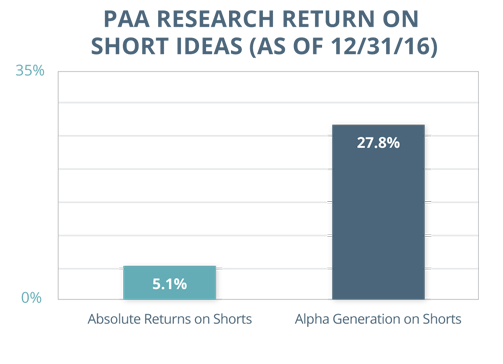
We are unique among
investment research firms

“The enemy of my enemy is my friend” Kautilya, Arthashastra This exact quote was used by the CEO of a major residential real estate brokerage firm to describe the private/premier...
READ MORE >This morning as we pored over the latest set of financials from FRPT, we couldn’t help but have a little chuckle amongst ourselves. FRPT will go down as one of the biggest “serial...
READ MORE >For those that have been “around the block” with Trupanion management the decision to eliminate internal rate of return (IRR) as a key performance indicator didn’t come as a surprise. For those...
READ MORE >The report below summarizes feedback we received from our proprietary surveys conducted across nine different industries: Decking dealers Powersports equipment Lighting Construction equipment Recreational vehicles Office...
READ MORE >Belieive it or not, we have been publishing the Watch List for a full decade now. Two things we wanted to highlight: 1) The NINE best performing short ideas from the October 2025 Watch List generated average ALPHA over the past 6-months of 49.1%! 2) Over the past...
READ MORE >Finally, we continue to work on technology innovation, including extensive use of AI models to drive automation in our business process, especially underwriting and claim handling and throughout our software development...
READ MORE >t’s never a good sign when the first headlines in a company’s earnings releases relate to a division that makes up less than 10% of total revenues. We probably shouldn’t expect too much from STRA management at this...
READ MORE >The attached report (in two parts) outlines our latest views on the residential real estate services space and housing market. The report is backed by feedback from more than 70 real estate agents arcross the...
READ MORE >The attached report (in two parts) outlines our latest views on the residential real estate services space and housing market. The report is backed by feedback from more than 70 real estate agents arcross the...
READ MORE >Are buybacks about to become a favorable factor for the markets? We asked this question a few months ago and the answer remains somewhat uncertain. Thus far this year, the S&P 500 Buyback Index is down a modest (3.5%) compared to a (-5.0%) decline for the S&P 500....
READ MORE >“Hey Jimmy, give me a cheese with nothing! Nothing????” Polly-O String Cheese commercial “We received an Excess proposal from $KNSL on our business. Pricing was fair. What concerns me is they omit a lot of...
READ MORE >“I don't see anything that gives me alarm around any sharper declines in U.S. Higher Education enrollment. And I'm confident that in time, it's going to normalize to...
READ MORE >No, FRPT will not be disintermediated by Cluade or any other AI model, at least not in the short term (if you want to go down the Citrini path, consumer stocks like FRPT could get demolished). However,...
READ MORE >The report below summarizes feedback we received from our proprietary surveys conducted across nine different industries: Decking dealers Powersports equipment Lighting Construction equipment Recreational vehicles Office...
READ MORE >Since the day the company went public, the mandate for Trupanion management has been one grand exercise in narrative creation and getting investors to focus on self-created (and oft changed)...
READ MORE >f you told us that FY26 and FY27 revenue estimates for Zillow would be higher on a 1, 3, 6, and 12-month basis and the stock would be down close to (-40%) over the past 6-months, we wouldn’t have believed you. Zillow shares have been under siege for the past...
READ MORE >It’s been an uninspiring start for TRUP shareholders thus far in 2026. The stock has declined (-14.0%) to start the year, compared to a modest 0.3% gain for the S&P 500. On a longer term basis, TRUP shares are down (-72.7%) over the past 5-years...
READ MORE >Believe it or not, there was a time in ATGE’s journey as a public entity that the company would be subject to some level of scrutiny from sell-side analysts and investors. No one would...
READ MORE >In our 25+ years following the for-profit education industry, there has never been a time when the overall level of angst was this high. Ongoing concerns about return on educational investment and student debt levels...
READ MORE >The report below summarizes current trends in the residential rental property market and feedback from our proprietary survey of rental property managers across the country. In 2026, we expect vacancy rates to increase and net effective rents to soften. This should...
READ MORE >“The enemy of my enemy is my friend” Kautilya, Arthashastra This exact quote was used by the CEO of a major residential real estate brokerage firm to describe the private/premier...
READ MORE >This morning as we pored over the latest set of financials from FRPT, we couldn’t help but have a little chuckle amongst ourselves. FRPT will go down as one of the biggest “serial...
READ MORE >For those that have been “around the block” with Trupanion management the decision to eliminate internal rate of return (IRR) as a key performance indicator didn’t come as a surprise. For those...
READ MORE >SELL/SHORT
$3.50
SELL/SHORT
$106
LONG
$126
LONG
$25
SHORT
$52
LONG
$110
SELL/SHORT
$230
LONG
$70
SELL/SHORT
$4
SELL/SHORT
$45
SELL/SHORT
$5
SELL/SHORT
$42
LONG
$75
SELL/SHORT
$50
SELL/SHORT
$50
PAIR TRADE
$10
PAIR TRADE
$30
SELL/SHORT
$10
SHORT
$101
SHORT
$15
SHORT
$0
SHORT
$22