PAA Research LLC Bradley.safalow@paaresearch.com
Pleaseactaccordingly.com (646) 753-0007
   
 
ESI 10-K Highlights, the “More You Learn, the More You Earn” Student Covenant Continues to Slip Away While Cohort Default Rates Remain Surprisingly Low

This report was originally published on 2/21/10.

ESI released its annual 10-K filing on Friday. We wanted to provide you with a few key observations and revisit some of the original tenets of our short thesis on the stock.  Overall, there was nothing in the 10K that we would characterize as “earth shattering”, although we anticipate many investors will be interested to learn more about the company’s preliminary cohort default rate data for FY08, which is included in the company’s 10-K.

ESI Revenues from Federal Financial Aid Sky-Rocketed in 2009, Even Though the Company’s 90/10 Compliance Actually Improved

As part of its 10-K, ESI provides investors with more detail on the percentage of revenue the company generates from funding sources such as the Federal Family Education Loan program (FFEL), Federal Pell Grants, and private lending.  Here are the highlights:

  • On a cash revenue basis, an astounding 84% of the company’s receipts came from Title IV programs in 2009.  To our knowledge this is the highest contribution that Title IV funds have represented as a percentage of ESI’s total revenues in the history of the company.  Clearly, ESI has benefited from higher student loan limits and expansion of the Pell Grant program.
  • For 90/10 purposes, ESI generated 70% of its revenues from Title IV funds on a cash accounting basis in 2009. No school generated more than 74% of its revenues from Title IV funds from 90/10 compliance purposes.  As a reminder, revenues generated from the increase in student loan limits enacted in July 2008 will not be included in the calculation until July 2011. We expect most companies in the for-profit education sector to witness a sizeable gap between the percentage of cash revenues generated from Title IV and their 90/10 compliance over the next several years due to this regulatory concession.
  • Pell Grants Are Now a Critical Source of Revenues for ESI.  Pell Grants represented 18% of ESI’s revenues in 2009, the highest level in the company’s history.  ESI has clearly benefited from the expansion in the Pell Grant program and increased funding limits per student. Stated another way, in 2006 ESI generated 11% of its revenues from Pell Grants, which implies they contributed $83 million to the company’s top-line. In 2009, Pell Grants accounted for $237 million of ESI’s total revenue – a three-fold increase!

In the chart below we outline ESI’s revenues by funding source over the past decade. It should become obvious that ESI is more reliant on federal financial aid than it ever has been.

Source: Company reports

Source: Company reports

How Does ESI Generate Such a High Percentage of Its Revenues from Title IV Funds?

It sounds like a fairly obvious and simple question, but there is a component of the answer that is often over-looked by investors in the for-profit education sector.  At the simplest level here’s what we know about the math surrounding tuition at the ITT Technical Institute and how students finance it.

  • The total cost of an associate’s degree at the ITT Technical Institute is now approximately $45,000 (please take a moment to absorb that).
  • Assuming that every student that applies to ITT Tech is an independent, they are eligible for $9,500 and $10,500 in Stafford loans in their first and second year of study, respectively.
  • Using these basic assumptions, an associate’s degree student would borrow $20,000 in Stafford loans to help finance their total associate’s degree tuition of $45,000.  This would imply that ESI should generate 44-45% of its revenues from FFEL ($20,000/$45,000), not the 66% the company reported in 2009.

How can we reconcile the discrepancy? It is a little known or discussed fact that students in their last two quarters of an associate’s degree program are considered third-year students for federal financial aid purposes.  ESI has structured its academic programs using a quarterly credit hour system. Under federal financial aid regulations, a student is considered a second year student once they have completed 36 credits in a quarter based program.  That student is then considered a third year student when 72 credit hours have been completed.  In order to earn an associate’s degree at the ITT Technical Institute a student must complete 96 credit hours, which means that for the last 24 credit hours that student is considered a third year student and has an additional Stafford loan borrowing limit of $12,500.  Under the same methodology, students completing their last 36 credit hours of the 180 required to obtain a bachelor’s degree at ITT Tech are considered fifth year students for federal financial aid purposes.  In the table below we compare the classification of academic year for federal financial aid purposes between traditional semester based programs and quarterly programs.

Source: Department of Education

Source: Department of Education

It seems somewhat illogical that a student completing their associate’s degree program (a 2-year program) can be considered a third-year student for federal financial aid purposes. This is not an ESI specific issue, but an industry-wide phenomenon.  There’s a reason beyond pedagogy and enhanced facility utilization that most schools in the for-profit education sector have employed a quarterly academic model.  It helps to maximize federal financial aid funding for students.  The notion of double-dipping in the federal financial aid pool has received close attention of late as it relates to Pell Grants.  Recent expansion of the program has enabled students to secure Pell Grants twice within one calendar year.  There’s a reason outside of target student demographic that for-profit institutions received 25% of Pell Grant funding a year ago, even though they only accounted for 10-12% of total enrollments in the U.S.

Revisiting Our Original Short Thesis On ESI

Approximately 10-months ago, we published a report entitled “Whatever Happened to the More You Learn, the More You Earn? The Structural Problems With ESI’s Business Model“.  It has been one of the most popular reports we have published. At the time we recommended that investors sell or short ESI shares based on the following:

  1. Over the next few quarters, ESI will continue to benefit from strong demand for its programs caused by the economic downturn. This is already reflected in consensus – strength should be sold or shorted.
  2. ESI has broken “the more you learn, the more you earn” student covenant.
  3. Student debt burden to attend ITT Tech now rivals mortgage debt burden at the peak of the housing bubble – cohort default rates should continue to surge higher.
  4. Our proprietary survey suggests that students are finding it increasingly difficult to make student loan payments.
  5. ESI has not disclosed that it is subject to a qui tam lawsuit based on alleged violations of the incentive compensation provisions of the Higher Education Act.
  6. ESI is over-earning at the expense of its students – tuition price cuts will become a necessary remedy for the company to fix its business model, in our view. We estimate that restoring the affordability of ESI’s programs could negatively impact EPS by $2.50-$3.00 in 2010, if not more.

Our investment thesis appears as compelling today as it did 10-months ago.  At the time we published our original report we speculated that the company could witness a sharp uptick in its cohort default rates as a result of low returns (if not negative) on educational investment and high student debt burdens for graduates.  We thought high cohort default rates could become a catalyst for ESI to witness greater regulatory scrutiny.  It appears that this particular element of our investment thesis was incorrect based on the preliminary FY08 cohort default rate data ESI disclosed in its 2009 10-K.

ESI’s Cohort Default Rates Remain Surprisingly Low

For FY08 (captures students delinquent on student loan payments as of January 2009), ESI’s preliminary cohort default rate according to the Department of Education ranged between 3.6% and 15.5% for its schools.  This compares to a range of 2.7% to 15.2% for FY07.  We are stunned by both the absolute level of cohort default rates and the small increase from FY07 to FY08.  COCO (17.75 ↑1.89%)witnessed a 4% average increase across its school network from FY07 to FY08.  We thought ESI would witness a similar, if not larger increase than COCO given the high price points for its programs, declining placement rates, and low starting salaries for graduates.  Thus far this has not come to fruition.

ESI is also bucking another trend with its cohort default rate data.  Historically for-profit education institutions that have witnessed a sharp increase in revenues from Pell Grants have seen a commensurate uptick in cohort default rates.  Think about it this way, COCO generated approximately 23% of its revenues from Pell Grants in FY09 and at this stage most investors are familiar with the company’s target student demographic and high cohort default rates.  Perhaps a sharp rise in ESI’s cohort default rates is still on the come or the company does a superior job of managing risk on the “back-end”.  Almost every single form of credit witnessed a rapid increase in delinquencies from 2008 to 2009 (the end of the measurement period for FY07 and FY08 cohort default rates), and yet ESI’s data reflects almost no change.  It is puzzling.

Whatever Happened to “the More You Learn, the More You Earn”?

The for-profit education space was effectively founded on the principle that “the more you learn, the more you earn” student covenant.  In the early days of the sector, for-profit education companies, including ESI, offered programs that were reasonably priced and offered students a compelling return on educational investment.  After more than a decade in which yearly tuition price increases have more than doubled the annual gain in starting salaries for its graduates, ESI has eroded return on educational investment to the point where it is highly questionable, if not outright negative, in our opinion.  Annual tuition has increased at a 7% CAGR since 1996, while starting salaries for ESI’s graduates (those who obtain job placement) have grown at a 3% rate.  This is an unsustainable trend to say the least.

We wanted to revisit a few data series in which we laid out the likely student loan servicing costs for ESI’s graduates at this point and how that compares to borrower mortgage burdens at prior peaks in the housing cycle.  First, students graduating from ESI’s associate’s and bachelor’s degree likely paid a total of $45,000 and $80,000 over their period of study.  We estimate those same degrees could cost as much as $47,000 and $90,000 for students starting those programs in 2010.  According to ESI management, the job placement rate for 2009 graduates was 74.6% at an average starting salary of $31,500 through January 2010.  As we have stated in the past, those numbers suggest that students are likely better off not attending ITT Tech at all.  In the table below, we compare the total cost of degree to average starting salary over the past 14-years. As you can see, the cost of ESI’s associate’s degree program is 140%+ of average starting salary and that for a bachelor’s degree 250%+.  These are troubling statistics.

ESI: Cost of Degree vs. Starting Salary for GraduatesFrom a student debt burn perspective, the statistics are equally concerning. In the table below we compare the percentage of gross income an associate’s degree graduate of ITT Tech in 2009 would allocate to student loan payments to that for mortgage borrowers at prior housing cycle peaks. According to our analysis, ESI’s 2009 associate’s degree graduates might allocate as much as 20% of their gross income to student loan payments.  This is before shelter, food, and transportation costs. The student debt burden appears to be unsustainable and is close to matching the levels witnessed in prior housing cycle peaks.

Source: PAA Research

Source: PAA Research

In our analysis, we have assumed that students fund their tuition entirely with loans. Given the percentage of ESI’s students that now get Pell Grants, one could argue that we have overstated graduate debt burdens. Overall, the contribution of Pell Grants does not change the conclusions of this analysis meaningfully.  We are not the only ones concerned about student debt burdens.  As part of the Negotiated Rulemaking process for 2009, the Department of Education proposed a “gainful employment” provision, which would effectively limit the amount of tuition a school could charge based on starting salaries for its graduates.  The initial proposal contemplated an 8% debt/income ratio for graduates.  Based on our analysis, ESI’s graduates have a debt burden of more than twice the proposed level as a result of the company’s tuition policies and low starting salaries.

The battle over the “gainful employment” provision in Negotiated Rulemaking will be brutal. For-profit providers of postsecondary education have a lot at stake.  However, at the end of the day it’s the Department of Education’s call. Who in the government will oppose a provision that lowers tuition costs for students? That would be political suicide.  Tuition trends across the entire higher education sector are unsustainable. Every man, woman, and child in this country wants to pay less to go to college.  With this type of support, it’s not hard to see why Secretary Duncan and Mr. Shireman have pursued this policy initiative.

The “gainful employment” provision was never part of our original investment thesis on ESI.  It appears that people within the Department of Education have started to look at tuition pricing for certain for-profit education companies in a similar manner as we do.  In our original report, we argued that reducing tuition to the point where the return on educational investment would be restored for the student could cost ESI as much as $2.50-$3.00 in EPS.  If the government’s 8% debt/income ratio policy is implemented, the negative impact on ESI’s EPS could be far larger.

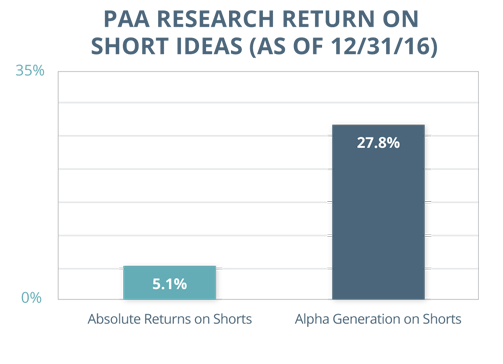
Our short call on ESI has delivered a modest return, but the stock has underperformed almost every major index over the past 10-months.  Fundamentally the thesis has yet to play out, but the stock has already witnessed substantial multiple compression.  We continue to think that ESI needs to take drastic steps to restore the return on educational investment for its students.  Large tuition reductions are the most likely and the most effective remedy in our opinion.

As always, please act accordingly…

  View As PDF